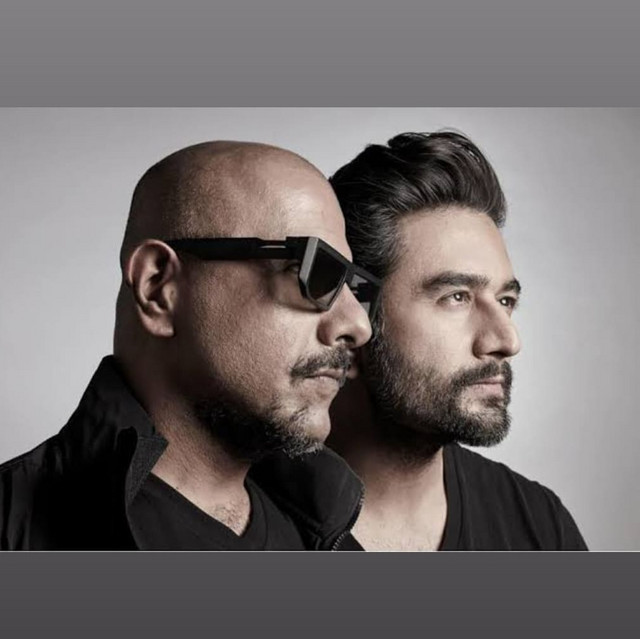
Biography
Vishal–Shekhar: Twenty-Five Years of Bollywood's Defining Sound
Origins: Childhood Friends to Creative Partners
Vishal Dadlani and Shekhar Ravjiani grew up in Mumbai as childhood friends, each absorbing music through different pathways. Dadlani emerged from the city's independent rock and electronic scene as the frontman of Pentagram, one of India's pioneering electronica-rock bands formed in the mid-1990s. Ravjiani pursued formal training in Hindustani classical music under Ustad Niaz Ahmed Khan and learned the accordion from his father Hasmukh Ravjiani, a music enthusiast; he also competed on Zee TV's Sa Re Ga Ma Pa in 1997. Their professional convergence occurred serendipitously in 1999 when both were independently hired to compose tracks for the film Pyaar Mein Kabhi Kabhi — Dadlani contributing "Woh Pehli Baar" and "Musu Musu Hasi" with his Pentagram bandmates, Ravjiani adding "Dil Se Mere Door Na Jana." Meeting in the studio, they recognised a complementary synergy: Dadlani's electronic production fluency and rock sensibility paired with Ravjiani's classical grounding and melodic intuition. They formally launched Vishal–Shekhar shortly thereafter, beginning a collaboration that has now spanned more than a quarter-century.
Breakthrough and the Techno Turn (2003–2007)
The duo's first full soundtrack, Vadh (2002), went largely unnoticed, but Jhankaar Beats (2003) announced their arrival. The album's lead single "Tu Aashiqui Hai" and the reflective "Suno Na" showcased a fresh electronic palette — synthesised textures, programmed beats, and hook-driven songwriting — that felt new to Hindi film music. The Filmfare R. D. Burman Award for New Music Talent validated their approach. They quickly followed with Supari (2003) and Musafir (2004), the latter yielding "Saaki" and "Door Se Paas," tracks that fused techno rhythms with Indian folk inflections; "Allah Ke Bande" from Waisa Bhi Hota Hai Part II (2003), sung by Kailash Kher, became a crossover spiritual-anthem hit. By 2005, major banners were calling: Dus, Salaam Namaste, and Bluffmaster released in a single year, with Dus earning their first Filmfare Best Music Director nomination. The streak continued through Golmaal: Fun Unlimited (2006), Ta Ra Rum Pum (2007), and the landmark Om Shanti Om (2007), whose retro-disco pastiche — "Main Agar Kahoon," "Dard-e-Disco," "Aankhon Mein Teri" — won the Asian Film Award for Best Composer and a second Filmfare nomination.
Mainstream Dominance and Global Collaborations (2008–2017)
The year 2008 marked Vishal–Shekhar's consolidation as Bollywood's pre-eminent hitmakers with four major soundtracks — Tashan, De Taali, Bachna Ae Haseeno, Dostana — each producing enduring singles: "Falak Tak Chal Saath Mere," the RD Burman-reimagined "Bachna Ae Haseeno" title track, "Khuda Jaane," and the ubiquitous "Desi Girl." Dostana brought a third Filmfare nomination. After a quiet 2009 (Aladin), 2010 delivered three high-profile albums: Anjaana Anjaani ("Tujhe Bhula Diya," "Aas Paas Khuda"), I Hate Luv Storys ("Bin Tere," "Bahara"), and Tees Maar Khan, whose "Sheila Ki Jawani" became a cultural phenomenon. The Mirchi Music Award for Listeners' Choice Song of the Year confirmed its mass appeal.
International collaboration became a hallmark in this period. Ra.One (2011) featured Akon on "Chammak Challo," a global dance hit that won the IIFA Award for Best Song Recording and the GiMA Award for Best Film Song. The Dirty Picture (2011) countered with the retro item number "Ooh La La" (Mirchi Best Item Song winner) and the Sufi-tinged "Ishq Sufiana." Student of the Year (2012) produced the wedding-staple "Radha" (Mirchi Listeners' Choice Song and Album of the Year) and "Ishq Wala Love." Chennai Express (2013) deepened their partnership with Shah Rukh Khan's Red Chillies Entertainment, yielding "Lungi Dance" (promotional, by Yo Yo Honey Singh) and the romantic "Titli" and "One Two Three Four." Happy New Year (2014) added "Manwa Laage" and "Indiawaale." Sultan (2016) and Befikre (2016) demonstrated range: the former's "Jag Ghoomeya" and "Baby Ko Bass Pasand Hai" balanced earthy romance with arena pop, while the latter's "Nashe Si Chad Gayi" became the first Indian song to surpass 300 million YouTube views (now exceeding 600 million). The Vamps collaboration "Beliya" (2016) and Diplo remixes further signaled global ambition. Tiger Zinda Hai (2017) delivered "Dil Diyan Gallan" and the record-setting "Swag Se Swagat," noted as the fastest song worldwide to reach 100 million views.
Recent Chapter: YRF Spy Universe and 25-Year Milestone (2019–Present)
The late 2010s and early 2020s saw Vishal–Shekhar anchor the musical identity of Yash Raj Films' spy franchise. War (2019) gave the viral "Ghungroo"; Pathaan (2023) produced the global smash "Besharam Rang" and "Jhoome Jo Pathaan," with the former winning the 2024 Mirchi Music Award for Music Composer of the Year — their first Mirchi win in that category since 2010. Fighter (2024) extended the partnership with Siddharth Anand. Simultaneously, Bharat (2019) earned their tenth Filmfare Best Music Director nomination. The duo have also revisited their own catalogue, recreating "Dus Bahane" as "Dus Bahane 2.0" for Baaghi 3 (2020).
In 2025, Vishal–Shekhar celebrated 25 years of partnership with a major world tour, joined onstage by guests including Akon, Arijit Singh, and Hamsika Iyer. Reflecting on their longevity in a March 2026 Bombay Times interview, both emphasised that creative disagreement — "creative clashes" — remains central to their process: "Some of our best compositions have come out of creative clashes. Even when we don't see eye to eye, the key is trusting each other's instincts." They described their dynamic as fluid and non-hierarchical — "Anyone can do anything" — with individual identity preserved within the duo: "Every person needs an individual identity, even within a partnership." Ravjiani continues independent Marathi work; Dadlani remains active with Pentagram and social advocacy. As they enter their third decade, Vishal–Shekhar's catalogue — over 350 film soundtracks, 72 number-one singles, and billions of streams — stands as a testament to a partnership that has continually reinvented itself while keeping, in Shekhar's words, "the joy of creating something bigger than either of us" at its core.
Artistry: Process, Influences, and Signature Sound
Vishal–Shekhar's creative process resists fixed roles. In the studio, a melody may originate from either partner — hummed into a phone, worked out on accordion or guitar, or sparked by a director's narration — and the other builds, rearranges, or rewrites. Sessions occur in cars, coffee shops, or across continents via voice notes. "It's unstructured, but it has its own rhythm, a method to madness," Dadlani explains. Their sound synthesises Dadlani's electronic-rock edge (shaped by Pentagram and influences from Nine Inch Nails to The Prodigy) with Ravjiani's classical discipline and gift for singable, emotionally direct melodies. The result is a versatile palette: high-energy dance anthems ("Dus Bahane," "Sheila Ki Jawani," "Swag Se Swagat"), intimate romantic ballads ("Khuda Jaane," "Bin Tere," "Dil Diyan Gallan"), retro pastiches (Om Shanti Om's disco homage), Sufi-inflected spiritual numbers ("Allah Ke Bande," "Ishq Sufiana"), and contemporary EDM-pop ("Nashe Si Chad Gayi," "Besharam Rang").
Lyrically, they collaborate with a rotating roster of writers — Kumaar, Irshad Kamil, Amitabh Bhattacharya, Vishal Dadlani himself — adapting to each film's narrative needs. Vocally, both perform their own compositions: Dadlani's gritty, rock-tinged timbre suits high-octane tracks; Ravjiani's smoother, classically honed voice carries softer melodies. Their judge/mentor roles on Indian Idol, Sa Re Ga Ma Pa, The Stage, and MTV Hustle have also shaped a secondary public persona as talent nurturers and industry elders. While occasionally outspoken on social issues — Dadlani notably petitioned against live media coverage of the 2008 Mumbai terror attacks rescue operations — they maintain a public boundary around private life, directing focus toward the music.
Selected moments
Career highlights
-
Formation and First Film Credit
Childhood friends Vishal Dadlani and Shekhar Ravjiani meet in the studio while scoring Pyaar Mein Kabhi Kabhi; decide to form Vishal–Shekhar.
-
Breakthrough with Jhankaar Beats
Debut full soundtrack Jhankaar Beats wins Filmfare R. D. Burman Award for New Music Talent; introduces techno-electronic sound to mainstream Bollywood.
-
Prolific Year: Dus, Salaam Namaste, Bluffmaster
Three major soundtracks in one year establish commercial dominance; Dus earns first Filmfare Best Music Director nomination.
-
Asian Film Award for Om Shanti Om
Win Best Composer at the 2nd Asian Film Awards for Om Shanti Om; album becomes a retro-disco landmark.
-
International Collaboration on Ra.One
Feature Akon on "Chammak Challo"; song wins IIFA Best Song Recording and GiMA Best Film Song; soundtrack earns Filmfare nomination.
-
YouTube Milestone with Nashe Si Chad Gayi
"Nashe Si Chad Gayi" from Befikre becomes first Indian song to cross 300 million YouTube views; eventually exceeds 600 million.
-
Record-Setting Swag Se Swagat
"Swag Se Swagat" from Tiger Zinda Hai becomes fastest song worldwide to hit 100 million YouTube views; reaches 650 million in first year.
-
Pathaan and Spy Universe Leadership
Compose "Besharam Rang" and "Jhoome Jo Pathaan" for YRF's Pathaan; "Besharam Rang" wins 2024 Mirchi Music Composer of the Year.
-
Fighter Extends Siddharth Anand Partnership
Score Fighter (2024), continuing collaboration with director Siddharth Anand across War, Pathaan, and Fighter.
-
25th Anniversary World Tour
Celebrate 25 years as a duo with global tour featuring guest appearances by Akon, Arijit Singh, and Hamsika Iyer.