Biography
Coldplay biography
Formation in London
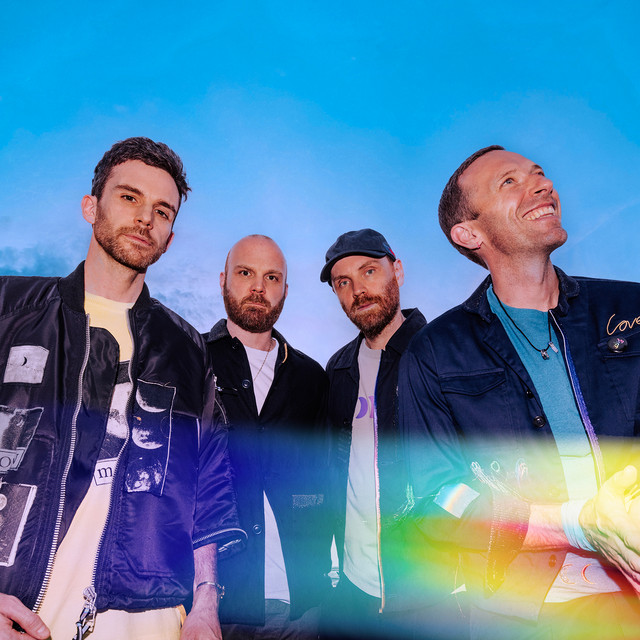
Coldplay formed around four students who met at University College London in the second half of the 1990s. Chris Martin and Jonny Buckland began writing and rehearsing together, Guy Berryman joined on bass, and Will Champion completed the lineup on drums. Champion had not established himself as a drummer before joining, but the four-piece quickly developed the arrangement that has remained at the center of the band. Phil Harvey, a friend of Martin's, became their early manager and later an enduring creative director, a role that led the group to describe him as a fifth member.
After using the names Pectoralz and Starfish, the band adopted Coldplay before its first documented concert at the Laurel Tree pub in Camden on January 16, 1998. The self-financed Safety EP followed that year, and the Brothers & Sisters single appeared through Fierce Panda in 1999. Coldplay signed with Parlophone and released The Blue Room EP later in 1999, establishing the combination of Martin's high, direct vocal melodies, Buckland's spacious guitar lines, Berryman's restrained bass playing, and Champion's economical drumming that would define its early records.
Parachutes and the first breakthrough
Coldplay's debut album, Parachutes, arrived in 2000. Its sound was intimate and uncluttered, built around acoustic guitar, piano, and songs that favored emotional clarity over technical display. Shiver introduced the band to a wider British audience, while Yellow became its international breakthrough and gave the album a durable center. Trouble and Don't Panic extended the record's quieter side. Parachutes reached No. 1 in the United Kingdom and later earned the GRAMMY Award for Best Alternative Music Album, turning a young London club band into an international touring act.
Rather than reproduce the debut, Coldplay made A Rush of Blood to the Head in 2002 with a heavier rhythmic and emotional range. In My Place, The Scientist, God Put a Smile upon Your Face, and Clocks each emphasized a different part of the group's vocabulary, from chiming guitar and piano balladry to more forceful rock arrangements. Clocks won Record of the Year at the GRAMMY Awards, and the album established Coldplay as a band capable of sustaining arena-scale attention without abandoning the melancholy and melodic directness of its first record.
X&Y and worldwide scale
X&Y followed in 2005 amid intense expectations. The album widened Coldplay's production, using synthesizers and denser layers around songs including Speed of Sound, Talk, The Hardest Part, and Fix You. Fix You became one of the band's defining live songs, moving from an organ-led opening into a communal final section. Although the album's difficult production period was widely discussed, its global commercial reach confirmed that Coldplay had moved beyond its post-Britpop beginnings and into the small group of British bands able to headline stadiums across multiple markets.
Viva la Vida and creative reinvention
For Viva la Vida or Death and All His Friends, released in 2008, Coldplay worked with Brian Eno, Markus Dravs, and Rik Simpson and deliberately disrupted its established habits. The group changed instruments, used orchestral and ambient textures, and organized the album around themes of revolution, power, mortality, and historical memory. Violet Hill supplied its sharpest rock edge, while the string-driven Viva la Vida became a global signature song. At the 51st GRAMMY Awards, Viva la Vida won Song of the Year and Best Pop Performance by a Duo or Group with Vocals, while the album won Best Rock Album.
The colorful concept album Mylo Xyloto followed in 2011. Produced with Eno and others, it paired electronic programming and large pop choruses with a dystopian love-story framework. Paradise and Every Teardrop Is a Waterfall became central to the accompanying tour, and Princess of China brought Rihanna into the band's catalog. The era showed how Coldplay could absorb contemporary pop production while retaining a recognizable melodic identity.
Ghost Stories, A Head Full of Dreams and Everyday Life
Ghost Stories, released in 2014, pulled inward after the scale of Mylo Xyloto. Its sparse electronic arrangements and songs about separation included Magic, Midnight, and A Sky Full of Stars, the latter produced with Avicii and built for the stadium environment that the rest of the album resisted. A Head Full of Dreams reversed the mood in 2015 with bright, collaborative pop, including Adventure of a Lifetime and Hymn for the Weekend. The band carried that celebratory approach into the Super Bowl 50 halftime show in 2016, where Beyonce and Bruno Mars joined the performance.
Coldplay then shifted again with Everyday Life in 2019. Presented as the two-part Sunrise and Sunset, the album drew from gospel, folk, orchestral music, and sounds from outside the band's usual pop-rock frame. It was less concerned with producing a single unified radio sound than with documenting social tension, faith, conflict, and human connection. The project reinforced a pattern running through Coldplay's career: large commercial records alternating with experiments that reset the group's working method.
Music of the Spheres and Moon Music
Music of the Spheres arrived in 2021 as a Max Martin-produced pop concept built around a fictional planetary system. Higher Power opened the era, and My Universe, recorded with BTS, reached No. 1 on the Billboard Hot 100. The collaboration connected two of the world's largest fan communities and became Coldplay's first US No. 1 single since Viva la Vida. The album received GRAMMY nominations for Album of the Year and Best Pop Vocal Album.
Moon Music, released in October 2024 as the second volume of the Music of the Spheres project, continued that expansive pop language while returning to themes of resilience, repair, and collective experience. The album included feelslikeimfallinginlove, WE PRAY, and ALL MY LOVE and reached No. 1 in both the United Kingdom and the United States. It became Coldplay's tenth studio album and fifth No. 1 album on the Billboard 200, extending a catalog that now connects the band's acoustic beginnings with electronic pop, orchestral rock, and global collaboration.
Live identity, sustainability and legacy
Coldplay's concerts have become a parallel body of work: wristband lighting, circular stages, audience participation, confetti, and long visual arcs are designed to turn large venues into shared spaces. For the Music of the Spheres World Tour, the band paired that spectacle with renewable-energy systems, rechargeable show batteries, kinetic floors, solar installations, lower-carbon travel incentives, and tree planting. Its published tour updates compare emissions with the preceding stadium cycle and make the environmental program unusually visible for a production of its size.
Across its career, Coldplay has treated accessibility as a creative discipline. The songs are often built from a small number of memorable musical ideas, but the surrounding production can move from bare piano to electronic rhythm, orchestral arrangement, or full-stadium release. That balance has allowed Yellow, Clocks, Fix You, Viva la Vida, Paradise, A Sky Full of Stars, and My Universe to come from very different eras while remaining recognizably Coldplay.
Selected moments
Career highlights
-
Live debut
Coldplay played its first documented show at the Laurel Tree pub in Camden on January 16, 1998.
-
Parachutes
The debut album introduced Yellow and later earned the band's first GRAMMY for Best Alternative Music Album.
-
A Rush of Blood to the Head
The second album became Coldplay's first Billboard 200 top-10 record, reaching No. 5.
-
Viva la Vida
At the 51st GRAMMY Awards, Viva la Vida won Song of the Year and the album won Best Rock Album.
-
Music of the Spheres
The ninth studio album received GRAMMY nominations for Album of the Year and Best Pop Vocal Album.
-
Moon Music
The band's tenth studio album, Music of the Spheres Vol. II: Moon Music, was released on October 4, 2024.
Recognition
Awards and recognition
Coldplay has received seven GRAMMY Awards from 34 nominations. Its wins span alternative, rock, pop, song, and record categories, reflecting both the band's album-scale work and the reach of individual songs. The list below records the band's GRAMMY wins rather than every award or nomination across its career.
- GRAMMY wins
- 7
- GRAMMY nominations
- 34
| Year | Award | Category | Work |
|---|---|---|---|
| 2002 | GRAMMY Awards | Best Alternative Music AlbumWinner | Parachutes |
| 2003 | GRAMMY Awards | Best Alternative Music AlbumWinner | A Rush of Blood to the Head |
| 2003 | GRAMMY Awards | Best Rock Performance by a Duo or Group with VocalWinner | In My Place |
| 2004 | GRAMMY Awards | Record of the YearWinner | Clocks |
| 2009 | GRAMMY Awards | Song of the YearWinner | Viva la Vida |
| 2009 | GRAMMY Awards | Best Pop Performance by a Duo or Group with VocalsWinner | Viva la Vida |
| 2009 | GRAMMY Awards | Best Rock AlbumWinner | Viva la Vida or Death and All His Friends |