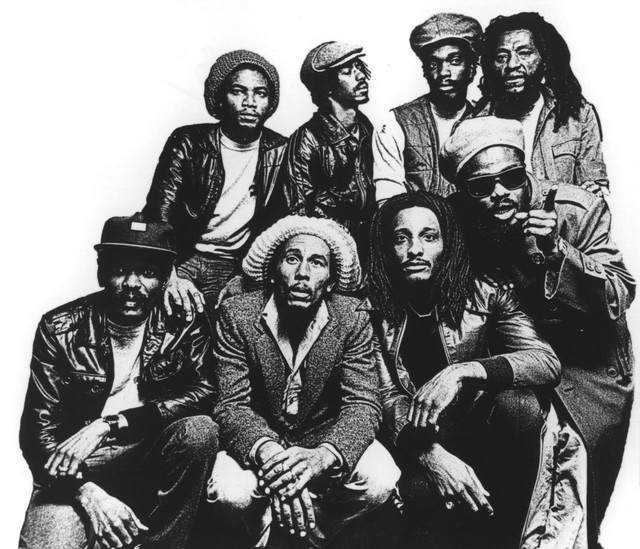
Biography
From Trenchtown to the World: The Story of Bob Marley & The Wailers
Origins in Trenchtown and the Studio One Years
The group that became Bob Marley & The Wailers formed in 1963 when teenagers Bob Marley, Peter Tosh, and Bunny Wailer — born Neville Livingston — began rehearsing under the tutelage of singer Joe Higgs in his Trenchtown yard. Higgs taught them harmony, melody, and the discipline of vocal arrangement, drawing inspiration from American groups like the Impressions. The trio initially performed as the Teenagers, then the Wailing Rudeboys and the Wailing Wailers, before settling on the Wailers. Junior Braithwaite, Beverly Kelso, and Cherry Smith rounded out the early lineup, contributing to the rich vocal textures of their first recordings.
In late 1963, producer Clement "Coxsone" Dodd auditioned the group at his Studio One facility. Backed by the Skatalites, they recorded "Simmer Down," Marley's admonition to Kingston's rude boys to cool their tempers lest "the battle would be hotter." Released in early 1964, the single shot to number one on the Jamaican charts, reportedly selling over 80,000 copies and announcing the Wailers as a force in the nascent ska scene. Follow-up singles including "Rude Boy," "I'm Still Waiting," and an early version of "One Love" kept them at the forefront through the mid-1960s as ska slowed into rocksteady. By 1966, Braithwaite, Kelso, and Smith had departed, leaving the core trio to navigate the shifting musical landscape.
The Perry Sessions and the Birth of Roots Reggae
A creative and commercial rupture with Dodd over royalty payments led the Wailers to establish their own short-lived label, Wail 'N' Soul 'M, in 1967. The venture folded within a year, but the period saw Marley's marriage to Rita Anderson and his deepening embrace of the Rastafari faith following Emperor Haile Selassie's 1966 visit to Jamaica. In 1970, the group entered a transformative partnership with producer Lee "Scratch" Perry. Perry paired them with his studio band the Upsetters — crucially, bassist Aston "Family Man" Barrett and drummer Carlton Barrett — forging a heavier, bass-driven sound that crystallized the emerging roots reggae idiom.
The Perry sessions yielded the albums Soul Rebels (1970) and Soul Revolution Part II (1971), along with seminal tracks such as "Duppy Conqueror," "400 Years," "Small Axe," and "Soul Rebel." These recordings established the Wailers' revolutionary sonic identity: Marley's guitar skanking in sync with the Barretts' hypnotic rhythm section, Tosh's biting keyboard lines, and Wailer's percussive accents, all framed by lyrics that fused biblical imagery with trenchant social critique. A dispute over royalty ownership of the Perry material prompted the group's departure, but the Barrett brothers remained, becoming the Wailers' permanent rhythm section.
Island Records and International Breakthrough
Stranded in London in 1972 after a failed CBS Records deal, Marley walked into Island Records' offices and met founder Chris Blackwell. Recognizing Marley's potential to bridge reggae and rock audiences, Blackwell advanced £4,000 — an unprecedented sum for a Jamaican act — to record an album. The Wailers returned to Kingston's Harry J Studio and laid down the tracks for Catch a Fire, released in April 1973. Blackwell's London overdubs, including guitarist Wayne Perkins and keyboardist John "Rabbit" Bundrick, gave the record a spacious, hypnotic texture tailored for rock listeners. The album garnered ecstatic UK press and secured tours of Britain and the United States, including an opening slot for Bruce Springsteen in New York.
Burnin' followed in October 1973, featuring "Get Up, Stand Up" (co-written by Tosh and Marley) and Marley's "I Shot the Sheriff." Eric Clapton's 1974 cover of the latter topped the Billboard Hot 100, dramatically expanding Marley's global profile. However, the Burnin' tour exposed fractures: Bunny Wailer refused the US leg, replaced by mentor Joe Higgs, and tensions over Blackwell's perceived favoritism toward Marley drove both Tosh and Wailer to leave the group in 1974, launching celebrated solo careers.
The Bob Marley & The Wailers Era: Natty Dread to Uprising
Marley rebuilt the ensemble as Bob Marley & The Wailers, anchored by the Barrett brothers, guitarists Al Anderson and later Junior Marvin, keyboardists Tyrone Downie and Earl "Wya" Lindo, percussionist Alvin "Seeco" Patterson, and the I-Threes — Rita Marley, Marcia Griffiths, and Judy Mowatt — whose gospel-inflected harmonies became the group's signature. Natty Dread (1974), the first album under the new name, introduced "No Woman, No Cry," "Lively Up Yourself," and the title track, reaching the UK top 50 and the US Billboard charts. A 1975 live version of "No Woman, No Cry" recorded at London's Lyceum Theatre became their first international hit single.
Rastaman Vibration (1976) cracked the US top 10, propelled by "War" — its lyrics drawn from Haile Selassie's 1963 UN speech — and "Roots, Rock, Reggae." In December 1976, days before the free Smile Jamaica concert intended to ease political violence, gunmen attacked Marley's Kingston home, wounding him, Rita, and manager Don Taylor. Marley performed anyway, then fled to London for 14 months. There he recorded Exodus (1977), a fusion of reggae, soul, and rock that remained on the UK charts for 56 weeks and spawned "Jamming," "Waiting in Vain," "One Love/People Get Ready," and "Three Little Birds." Kaya (1978) followed, lighter in tone but yielding the hit "Is This Love," while the live double album Babylon by Bus captured the band's ferocious stage power.
African Consciousness, Final Albums, and Marley's Death
Marley's 1978 pilgrimage to Ethiopia, spiritual homeland of Rastafari, deepened the pan-African vision that drove Survival (1979). Tracks like "Africa Unite," "Zimbabwe," and "Wake Up and Live" made the album an explicit manifesto for liberation. In April 1980, Marley & The Wailers performed at Zimbabwe's official independence ceremony at Rufaro Stadium; when tear gas dispersed the crowd outside, Marley returned to the stage alone to sing "Zimbabwe" as the new nation's first unofficial anthem. The final studio album of Marley's lifetime, Uprising (1980), balanced dancefloor appeal — "Could You Be Loved" hit US club and R&B charts — with the stark acoustic masterpiece "Redemption Song," a meditation on freedom and mortality.
Diagnosed with acral lentiginous melanoma in 1977 after a football injury, Marley refused amputation on religious grounds and continued touring. The 1980 Uprising Tour broke European attendance records, culminating in a 110,000-strong crowd in Milan. His last concert took place September 23, 1980, at Pittsburgh's Stanley Theater. After seeking alternative treatment in Germany, Marley died in a Miami hospital on May 11, 1981, aged 36. Jamaica awarded him the Order of Merit weeks earlier and accorded him a state funeral attended by Prime Minister Edward Seaga and opposition leader Michael Manley — the very rivals whose hands he had joined onstage three years prior.
Posthumous Legacy and the Enduring Wailers
Island Records released the posthumous album Confrontation in 1983, featuring "Buffalo Soldier," but the 1984 compilation Legend — curated as an accessible greatest-hits collection — became the definitive Marley document. It topped the UK charts, reached number five in the US, and has never left the Billboard Catalog Albums chart, with estimated global sales exceeding 28 million copies as of 2024. The Wailers Band, formed by Aston Barrett in 1989, and the Original Wailers, formed by Al Anderson and Junior Marvin in 2008, have kept the music alive on stages worldwide. Under the leadership of Barrett's son, Aston Barrett Jr., the Wailers released the Grammy-nominated albums One World (2020) and Evolution (2024), continuing the tradition of socially conscious reggae.
Marley's honors reflect his singular stature: the 1978 United Nations Peace Medal of the Third World; Jamaica's Order of Merit (1981); Rock and Roll Hall of Fame induction (1994); Time magazine's Album of the Century for Exodus (1999); BBC's Song of the Millennium for "One Love" (1999); Grammy Lifetime Achievement Award (2001); Hollywood Walk of Fame star (2001); Rolling Stone's 100 Greatest Artists at number 11 (2004); UK Blue Plaque at his first London residence (2006); Grammy Hall of Fame for Catch a Fire (2010); and Black Music & Entertainment Walk of Fame induction (2022). His songs remain fixtures at protests and liberation movements from Occupy Wall Street to the 2020 global demonstrations against police brutality, confirming the timeless urgency of his call to "get up, stand up."
Selected moments
Career highlights
-
First Jamaican Number One
"Simmer Down" tops the Jamaican charts, establishing the Wailers as leading voices in ska and selling a reported 80,000 copies on Studio One.
-
Lee "Scratch" Perry Collaboration
The Wailers record Soul Rebels and Soul Revolution Part II with Perry and the Upsetters, forging the deep bass-and-drums foundation of roots reggae and recruiting the Barrett brothers.
-
Island Records Debut: Catch a Fire
First major-label album brings international distribution, rock-studio production, and critical acclaim; launches UK and US tours including opening for Bruce Springsteen.
-
Transition to Bob Marley & The Wailers
Departure of Peter Tosh and Bunny Wailer leads to new lineup with the I-Threes and Wailers Band; Natty Dread becomes first album under new name, yielding "No Woman, No Cry."
-
Rastaman Vibration Breaks US Top 10
Album peaks at No. 8 on Billboard 200, the band's highest US chart position during Marley's lifetime; "War" adapts Haile Selassie's UN speech into a global equality anthem.
-
Exodus: 56 Weeks on UK Charts
Recorded in London exile after assassination attempt, Exodus fuses reggae with soul and rock, yields four UK hit singles, and is later named Time magazine's Album of the Century.
-
One Love Peace Concert and UN Peace Medal
Marley joins hands of Prime Minister Michael Manley and opposition leader Edward Seaga onstage in Kingston; receives UN Peace Medal of the Third World in New York.
-
Zimbabwe Independence Concert
Invited to perform at the liberation ceremony; when tear gas clears the stadium, Marley returns alone to sing "Zimbabwe" as the new nation's unofficial anthem.
-
State Funeral and Order of Merit
Jamaica awards its third-highest honor weeks before Marley's death on May 11; state funeral draws hundreds of thousands, attended by both major political leaders.
-
Legend Becomes Best-Selling Reggae Album
Posthumous compilation tops UK charts, reaches US top five, and achieves estimated 28 million global sales — the best-selling reggae album in history.
-
Rock and Roll Hall of Fame Induction
Marley inducted at ninth annual ceremony with Bono presenting and Rita Marley accepting; cited for expanding reggae from Jamaican sound to global force.
-
Grammy Lifetime Achievement and Hollywood Walk of Fame
Recording Academy honors Marley's creative contributions of outstanding artistic significance; 2171st star dedicated on Hollywood Boulevard on his birthday, February 6.
Recognition
Major Awards and Honors
Bob Marley & The Wailers' frontman Bob Marley received Jamaica's third-highest national honor, the Order of Merit, in April 1981, weeks before his death, and was accorded a state funeral attended by the nation's political leadership. The United Nations awarded the Peace Medal of the Third World in June 1978 for his courageous mediation at the One Love Peace Concert. Posthumous recognition has been extensive, reflecting his unique status as a musician whose influence transcended entertainment to shape global movements for justice and African unity.
- Grammy Lifetime Achievement Awards
- 1
- Rock and Roll Hall of Fame Inductions
- 1
- Grammy Hall of Fame Entries
- 1
- UK Number One Albums
- 1
| Year | Award | Category | Work |
|---|---|---|---|
| 1978 | United Nations Peace Medal of the Third World | Peace and JusticeWinner | One Love Peace Concert mediation |
| 1981 | Jamaican Order of Merit | Arts and CultureWinner | |
| 1994 | Rock and Roll Hall of Fame | PerformerWinner | |
| 1999 | Time Magazine Album of the Century | AlbumWinner | Exodus |
| 1999 | BBC Song of the Millennium | SongWinner | One Love |
| 2001 | Grammy Lifetime Achievement Award | Lifetime AchievementWinner | |
| 2001 | Hollywood Walk of Fame Star | RecordingWinner | |
| 2004 | Rolling Stone 100 Greatest Artists of All Time | Artist RankingWinner | |
| 2006 | UK Blue Plaque | Cultural HeritageWinner | First London residence at Ridgmount Gardens |
| 2010 | Grammy Hall of Fame | Reggae AlbumWinner | Catch a Fire |
| 2022 | Black Music & Entertainment Walk of Fame | LegacyWinner |