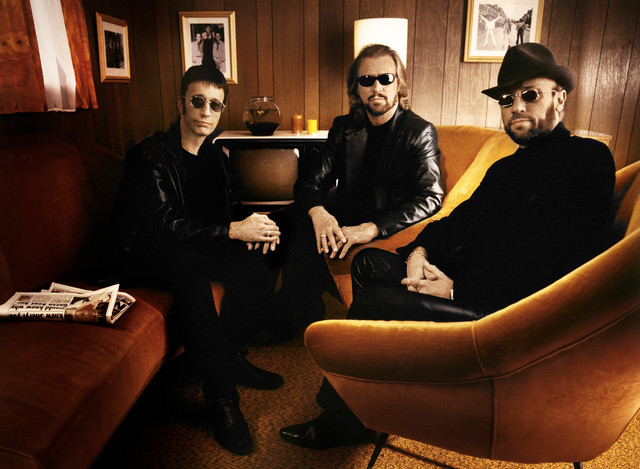
Biography
From Manchester stages to disco's summit
Manchester roots and the Australian move
Barry Gibb was born on 1 September 1946, and his twin brothers Robin and Maurice on 22 December 1949, all on the Isle of Man to parents Hugh and Barbara Gibb. The family settled in Chorlton-cum-Hardy, Manchester, in 1955, where the boys began singing together and formed a skiffle and rock-and-roll group called the Rattlesnakes with school friends. At a December 1957 matinee at Manchester's Gaumont Theatre, a broken record forced them to perform live instead of miming, and the response pointed them toward a singing career.
In August 1958 the Gibb family emigrated to Australia and settled at Redcliffe, north of Brisbane. The brothers sang for crowds at the Redcliffe Speedway, where promoter Bill Goode introduced them to Brisbane radio presenter Bill Gates; Gates coined the name "BGs" from their initials, later rendered Bee Gees. Australian pop star Col Joye championed the act, helping them secure a 1963 recording contract with Leedon Records, a Festival Records subsidiary, and an opening slot on a Chubby Checker tour.
Australian apprenticeship, 1963-1966
As the Bee Gees, the group released singles through the mid-1960s while Barry also wrote for other Australian artists. Their 1965 single "Wine and Women" preceded a first album, and by 1966 Festival Records was ready to drop them. Producer and A&R man Nat Kipner moved them to Spin Records, where engineer Ossie Byrne gave the brothers extensive access to his St Clair Studio in Hurstville, letting them hone the writing, singing and production skills that would define their later work.
Their final Australian phase produced "Spicks and Specks," which became a home-country hit as the family sailed back to Britain in late 1966. Demo tapes had reached Brian Epstein's NEMS and then impresario Robert Stigwood, who auditioned them in February 1967. The resulting five-year contract sent Polydor releases to the United Kingdom and Atco to the United States, and Stigwood's campaign billed the Bee Gees as a leading new musical talent of 1967.
International breakthrough, 1967-1969
In their first year back in England, the Bee Gees placed "New York Mining Disaster 1941" in both the British and American top 20 and followed with "Holiday" and "To Love Somebody," a song originally written for Otis Redding. "Massachusetts" gave them a British No. 1, and albums such as Bee Gees 1st, Horizontal and Idea established a baroque pop sound that invited comparisons with the Beatles. "I've Gotta Get a Message to You" and "I Started a Joke" extended the run into the American top 10 in 1968 and 1969.
The lush 1969 double album Odessa proved too ambitious for the moment: the brothers disagreed over a potential single, and Robin left the group. Barry and Maurice recorded Cucumber Castle as a duo, while Robin's solo Robin's Reign yielded the British hit "Saved by the Bell." The separation was brief; by mid-1970 the brothers were recording together again, and Barry publicly vowed in August that the Bee Gees would never part, with drummer Geoff Bridgford joining as an official member.
Reunion and the Miami turn, 1970-1976
Reunited, the Bee Gees scored with "Lonely Days" and, in 1971, with "How Can You Mend a Broken Heart," which the Recording Academy identifies as the first of their nine Billboard Hot 100 No. 1 hits. Albums through the early 1970s sold less reliably, and by Mr Natural in 1974 the group sounded adrift. At Eric Clapton's suggestion they recorded at Criteria Studios in Miami, where producer Arif Mardin and Stigwood pushed them toward dance-oriented material.
Main Course, cut in Miami in 1975, changed everything: "Jive Talkin'" reached No. 1, "Nights on Broadway" followed, and Barry Gibb's falsetto, newly featured, became the group's signature. Children of the World extended the momentum with "You Should Be Dancing" and "Love So Right." Embracing Philadelphia-style soul and R&B rhythms they had long admired, the brothers fused their harmony craft with a club-ready pulse.
Saturday Night Fever and the disco summit, 1977-1979
For Robert Stigwood's 1977 film Saturday Night Fever the brothers wrote and sang material both as themselves and for other artists on the soundtrack. "How Deep Is Your Love" opened the campaign and topped the Hot 100 for three weeks, with "Stayin' Alive" and "Night Fever" following to No. 1. Recording Academy awards for the project included Album of the Year and Producer of the Year in 1979, adding to the 1978 win for "How Deep Is Your Love."
Chart dominance peaked in 1978, when the Kennedy Center notes the brothers held five songs in the U.S. top 10 simultaneously as writers. The run continued into 1979 with No. 1 singles "Too Much Heaven," "Tragedy" and "Love You Inside Out" and the album Spirits Having Flown. Beyond their own records, the Gibbs wrote and produced hits for Barbra Streisand, Diana Ross, Andy Gibb, Yvonne Elliman, Frankie Valli and, later, Kenny Rogers and Dolly Parton.
Later decades, honors, and legacy
American success cooled in the early 1980s, but the brothers kept writing for others — including Streisand's "Woman in Love," Dionne Warwick's "Heartbreaker" and Rogers and Parton's "Islands in the Stream" — before returning as performers with 1987's E.S.P. and the British No. 1 "You Win Again." The 1989 album One and a world tour followed. The Songwriters Hall of Fame honored them in 1994, the Rock and Roll Hall of Fame inducted them in 1997, and "Alone" returned them to the American top 30 that same year. This Is Where I Came In, released in 2001, became their final studio album.
Maurice Gibb died on 12 January 2003, and Barry and Robin retired the Bee Gees name rather than continue without him, accepting a GRAMMY Legend Award that year in his memory. Robin Gibb died on 20 May 2012. Recognition of the catalog continued with a Recording Academy Lifetime Achievement Award in 2015, the 2017 CBS salute Stayin' Alive: A Grammy Salute to the Music of the Bee Gees, the 2020 documentary The Bee Gees: How Can You Mend a Broken Heart, and a Kennedy Center Honor for Barry Gibb in 2023. Barry has since recorded and performed as a solo artist, including the 2021 Nashville project Greenfields.
Selected moments
Career highlights
-
Bee Gees formed in Queensland
After emigrating from Manchester in 1958, Barry, Robin and Maurice Gibb began performing around Redcliffe, where promoter Bill Goode and DJ Bill Gates helped fix the name that would carry their career.
-
International breakthrough under Robert Stigwood
Signing with Robert Stigwood weeks after arriving in England, the group issued "New York Mining Disaster 1941" and topped the U.K. chart with "Massachusetts" in their first year back in Britain.
-
Odessa triggers a temporary split
The ambitious Odessa album triggered a disagreement over its potential single, and Robin left briefly; Barry and Maurice continued as a duo while Robin recorded Robin's Reign before the 1970 reunion.
-
First Billboard Hot 100 No. 1
"How Can You Mend a Broken Heart" gave the Bee Gees their first U.S. chart-topper, opening a run that the Recording Academy counts at nine No. 1 hits through 1979.
-
Main Course redirects the sound
Recording at Criteria Studios in Miami with Arif Mardin, the group embraced R&B dance rhythms; "Jive Talkin'" reached No. 1 and Barry Gibb's falsetto became a signature of the group.
-
Saturday Night Fever soundtrack era
The brothers wrote and sang "How Deep Is Your Love," "Stayin' Alive" and "Night Fever" for the film's soundtrack, which brought them Grammy Awards including Album of the Year in 1979.
-
Five songs in the U.S. top 10 at once
The Kennedy Center notes the Bee Gees as the only songwriters with five songs simultaneously in the U.S. top 10, a peak of their combined writing and performing dominance.
-
Songwriters Hall of Fame induction
Barry, Maurice and Robin Gibb entered the Songwriters Hall of Fame at its 25th annual gala, recognizing a catalog that hundreds of other artists have recorded over the decades.
-
Rock and Roll Hall of Fame induction
Brian Wilson inducted the trio in 1997, and the Hall's induction essay credits the Bee Gees with more than 200 million records sold across more than forty years together.
-
GRAMMY Legend Award accepted
Barry and Robin Gibb accepted the GRAMMY Legend Award at the 45th Grammy Awards, weeks after Maurice's death, in a ceremony the Recording Academy has since revisited publicly.
-
Recording Academy Lifetime Achievement
The Recording Academy honored the Bee Gees with a Lifetime Achievement Award, presented during GRAMMY Week in 2015 alongside other Special Merit Awards recipients.
-
Kennedy Center Honor for Barry Gibb
Barry Gibb was part of the 46th Kennedy Center Honors class, celebrated in December 2023 for lifetime artistic achievement shaped by the Bee Gees songbook.
Recognition
Grammys, halls of fame, and lifetime honors
The Recording Academy credits the Bee Gees with five Grammy wins from nine nominations, with four awards at the 21st Annual Grammy Awards in 1979 for Saturday Night Fever-related work, including Album of the Year and Producer of the Year.
Recognition also came from the Songwriters Hall of Fame in 1994, the Rock and Roll Hall of Fame in 1997, a GRAMMY Legend Award in 2003, a Recording Academy Lifetime Achievement Award in 2015, and a Kennedy Center Honor for Barry Gibb in 2023.
- Grammy Awards won
- 5
- Grammy nominations
- 9
- Music halls of fame
- 2
| Year | Award | Category | Work |
|---|---|---|---|
| 1972 | Grammy Awards | Best Pop Vocal Performance by a Duo, Group or ChorusNominee | How Can You Mend a Broken Heart (single) |
| 1978 | Grammy Awards | Best Pop Vocal Performance by a GroupWinner | How Deep Is Your Love |
| 1978 | Grammy Awards | Best Producer of the YearNominee | |
| 1979 | Grammy Awards | Album of the YearWinner | Saturday Night Fever - Soundtrack |
| 1979 | Grammy Awards | Producer of the YearWinner | Bee Gees, Albhy Galuten, Karl Richardson |
| 1979 | Grammy Awards | Best Pop Vocal Performance by a Duo, Group or ChorusWinner | Saturday Night Fever |
| 1979 | Grammy Awards | Best Arrangement of VoicesWinner | Stayin' Alive |
| 1979 | Grammy Awards | Record of the YearNominee | Stayin' Alive (single) |
| 1994 | Songwriters Hall of Fame | Induction of Barry, Maurice and Robin GibbWinner | |
| 1997 | Rock and Roll Hall of Fame | Performer inductionWinner | |
| 2003 | Grammy Awards | Special Award of Merit (GRAMMY Legend Award)Winner | Bee Gees |
| 2015 | Recording Academy Lifetime Achievement Award | Special Merit AwardsWinner | Bee Gees |
| 2023 | Kennedy Center Honors | Lifetime artistic achievement (Barry Gibb)Winner |